
AI Is Humanity’s Most Powerful Tool — Let’s Stop Racing in the Wrong Direction
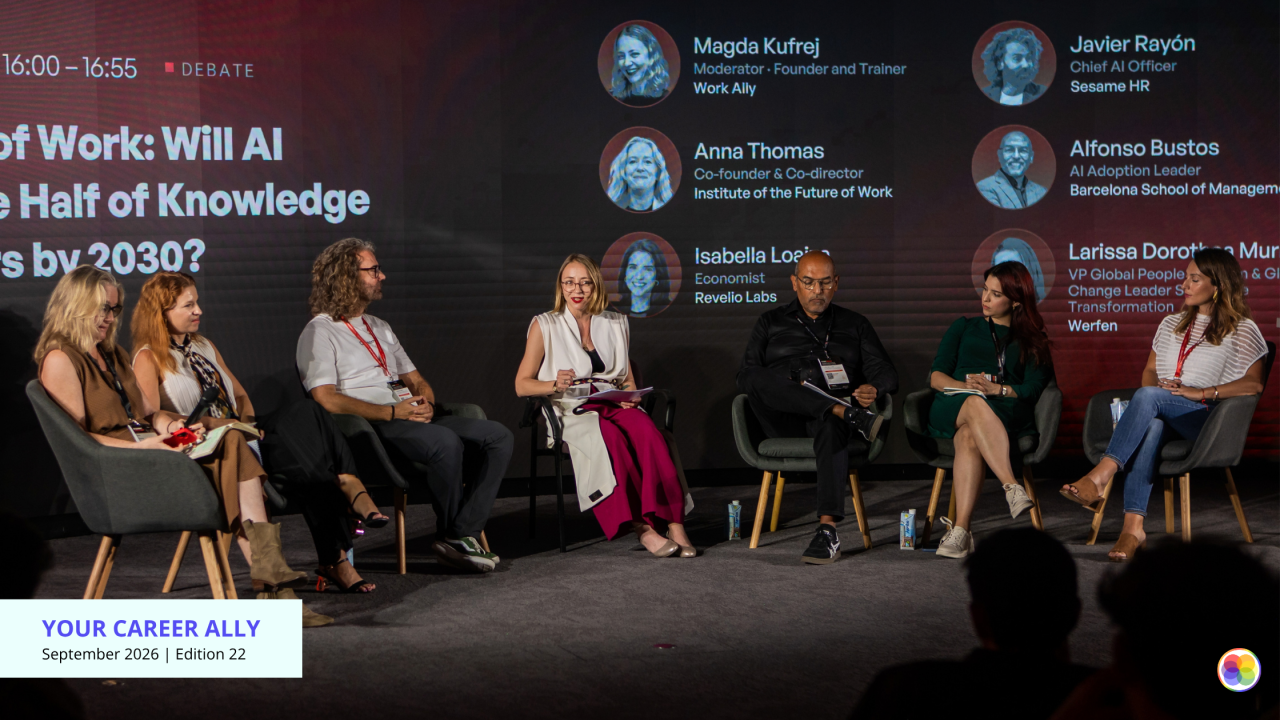
The AI Summit in Barcelona is over. It was inspiring, energising and exhausting, all at once.
For two days, people from very different fields discussed the AI transition: technical use cases, new business models, regulations, how AI is changing the way we work. Whatever discipline we came from, I think we all shared the same feeling. We are witnessing a historic moment for humanity.
I heard a lot about human agency, redesigning systems and adding friction. Some people argued that today’s AI is limited and years away from anything like its own intent. Others worried that we will soon stop understanding how it works, and lose control.
But we all agreed on one thing: AI is humanity’s most powerful tool so far. Perhaps too powerful for what we can handle as a global community today, when so many other crises are already testing us.
Here is what I’m taking home from the summit:
1. The decision can’t belong to the private sector alone.
Industry produced over 90% of notable AI models in 2025. At the same time, the average score on the Foundation Model Transparency Index fell from 58 to 40, and documented AI incidents rose from 233 to 362 (Stanford AI Index 2026).
A technology this powerful needs a UN-type global body and an inclusive process that protects the interests of all of humanity, not only the shareholders.
What we need are more transparency and globally bounding regulations, built together and aligned with the UN Sustainable Development Goals.
And until they are in place – AI development needs to slow down.
2. Change the direction. (Yes, I’m a dreamer.)
Instead of ever bigger general models whose modus operandi we are losing track of, let’s point AI at the goals that matter: hunger, climate adaptation, cancer treatment. Let’s start with the areas where AI already performs well and use the tools available today.
My suggestion, as an incurable idealist is: what if every AI giant stepped up to at least one global challenge as part of its mission?
Renewable energy, supply chain transparency, waste management, medical research, access to water. You name it.
As Max Tegmark, MIT professor, co-founder of Future of Life Institute and the author of the bestselling book “Life 3.0: Being Human in the Age of Artificial Intelligence” put it, the AI giants are racing in the wrong direction. If they raced towards solving the problems we already have, the race would finally make sense.
3. Everyone surrenders “AI on steroids” at once, or no one does.
Companies will only slow down if the same rules apply to everyone, everywhere, and that includes the US and China.
We did something like this with the atomic bomb: a few governments kept it under seal and highly regulated from the start.
This time the whole planet has to be at the table. The private sector will benefit enough anyway, and for once it could be “the good guys”.
Can this actually happen?
Would you give it even a 10% chance? I see only one way there:
→ Awareness: people everywhere understand the seriousness of AI and what it could mean for them, and learn to use the tool.
→ A snowball effect: experts and practitioners like the ones I met in Barcelona, together with grassroots movements, trade unions, and social justice and climate activists, bringing citizens and workers onboard. Encouraging people, the critical social mass, to show support, educate themselves, go to a protest, or boycott an AI provider that won’t comply.
Only in great numbers can we speak as a society.
I picture something big, like Fridays for Climate and Climate Weeks – but for this new emerging cause. Local hubs organizing workshops and meet-ups, AI literacy campaigns, AI information centres, volunteer capstone projects that put AI to work for the public good. And this is just a tip of the iceberg.
Your turn.
👉 Is this worth trying, even at 10%?
👉 What would you be willing to do: sign, show up, volunteer your skills?
👉 How do we build the snowball, and who should be in it from day one?
I’ll start: I’m ready to run AI literacy workshops for anyone who wants to join the conversation. Tell me in the comments where you’d start.
Let’s build the snowball together.
I created a LinkedIn group: AI FOR GOOD #AI4Good.
It’s a space for people who believe AI should serve humanity’s biggest challenges, not just shareholders. Practitioners, activists, educators, researchers, curious newcomers: everyone is welcome from day one. We’ll share ideas, organise workshops and meet-ups, and find ways to put our skills to work for the public good.
Thank you for all the conversations at the summit, and I’m curious what you think: how can we shape AI for good?
Anna Thomas, Isabella Loaiza, Larissa Dorothea Murmann, Javier Rayón, Alfonso Bustos, Alia Zafar, Laurence R. Nguyen Trong, Caroline De Cock, LL.M., Roberta Scrofani, MBA/Tech Fellow, Laura Sibony, Andy Storch, Irina Shevchenko, Fiona Garvey, Anita Perera, Rabia Qamar, Mark Hill, Marcin Kędzior, PhD., Julie McNealis, Mirela Frantz Cardinal, Samuel G. Villegas, Marina Barguno, Damien Acheson, Anna Via
— Magda
#AI #AIforGood #AI4Good #FutureOfWork #AIGovernance #AISummitBarcelona
